ACADEMICS

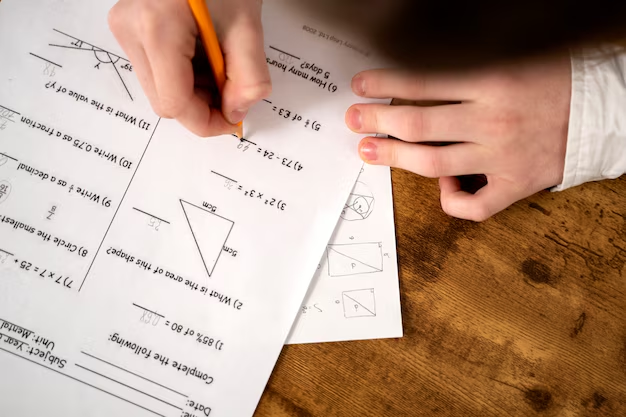
MATHS PROBLEM SOLVING ACTIVITY

LIBRARY

Library
These libraries are integral to the educational framework, providing students with access to diverse resources that enhance learning and encourage intellectual curiosity.
Reading books offers numerous benefits that enhance both personal and academic growth. Engaging in regular reading can strengthen the brain, increase empathy, reduce stress, and improve vocabulary and writing skills.
Click Here
Reading Books
School boasts a comprehensive library managed by a professional librarian. The library offers a wide array of print and digital materials, including books, magazines, newspapers, and online databases, serving as a vital resource for students.
Click Here
School Library
School libraries play a pivotal role in fostering a love for reading and supporting the academic growth of students. In Hyderabad, many schools are equipped with well-resourced libraries tailored to meet the educational needs of their students.
Click Here
Previous slide
Next slide

DRAWING AND COLOURING ACTIVITY

DRAWING
Coloring and drawing stimulate creativity by allowing students to express themselves artistically. Choosing colors and creating images encourage imaginative thinking and decision-making.
Click Here
COLOURING
Coloring can serve as an introduction to structured learning. It familiarizes younger students with working on paper, following instructions, and developing the discipline needed for more formal education.
By integrating coloring and drawing into daily routines, schools can support the holistic development of students, fostering both their academic and personal growth.
Click Here
Creativity and Imagination:
Engaging in coloring and drawing helps students improve their fine motor skills. The precise movements required to hold and maneuver writing instruments strengthen the muscles in the fingers, hands, and wrists, leading to better hand-eye coordination
Click Here
Previous slide
Next slide

SPORTS

Physical Education
Engaging in sports during school years offers numerous benefits, including physical fitness, teamwork, discipline, and improved mental health. Schools often organize various sports activities to promote these advantages among students.
Click Here
RACING
Traditional sprints and long-distance races that encourage speed and endurance.
Click Here
CYCLING
Cycling is a multifaceted activity that offers numerous benefits, especially for students. Incorporating cycling into daily routines can significantly enhance physical health, mental well-being, and social skills.
Click Here
Previous slide
Next slide

Science

LABORATORIES
Laboratory experiments, scientific research, and theoretical studies in subjects like biology, chemistry, and physics.
Click Here

EXCURSION

FUN MOMENTS
School excursions are integral to the educational experience, offering students opportunities to engage with the world beyond the classroom. These trips enhance learning by providing practical exposure, fostering social skills, and igniting curiosity.
Click Here
Enhanced Engagement
Interactive environments stimulate interest and motivation in various subjects.
Group excursions promote teamwork, communication, and interpersonal skills among peers.
Click Here
Experiential Learning
By thoughtfully organizing excursions, schools can provide enriching experiences that complement classroom learning and contribute to the holistic development of students.
Click Here
Previous slide
Next slide

SCHOOL CURRICULAR ACTIVITIES

School curricular activities encompass the core academic programs and subjects that form the foundation of a student’s education.         These activities are integral to the school’s curriculum and are designed to impart essential knowledge and skills across various disciplines.

Examples of Curricular Activities:

  • Language Arts: Reading comprehension, essay writing, grammar exercises, and literature analysis.

  • Mathematics: Problem-solving, algebra, geometry, calculus, and statistical analysis.

  • Science: Laboratory experiments, scientific research, and theoretical studies in subjects like biology, chemistry, and physics.

  • Social Studies: History projects, geography assignments, and civics education.

  • Physical Education: Structured physical activities and sports that are part of the school’s curriculum

These activities are typically mandatory and are assessed through various forms of evaluation, contributing to a student’s academic grades.

In contrast, co-curricular activities are programs and experiences that complement the academic curriculum. They include activities such as sports, debate, and community projects outside the classroom. These activities significantly enhance students’ academic performance and serve as a groundwork for holistic development and fostering essential skills beyond academics.


Both curricular and co-curricular activities play crucial roles in a student’s education, ensuring a balanced development of academic proficiency and essential life skills.

Scroll to Top